The Paper Engineer
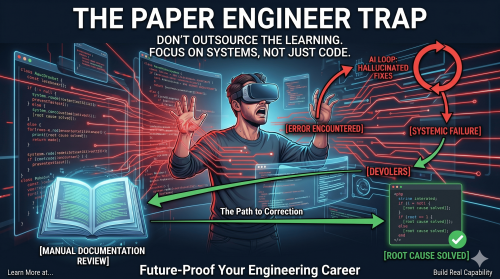
Right now, it is too easy to let an AI write your code while you skip the learning. The bug gets fixed, but your understanding doesn't move. We are trading our future capability for present-day speed, and the tools won't force us to do otherwise.
There is a default loop most of us have settled into. You paste an error message into a model. The model hands you a fix. The error vanishes. You ship it.
Somewhere in that loop, the messy, painful struggle between problem and solution stops happening entirely. Across thousands of these small interactions, what you can actually build without an AI looking over your shoulder gets weaker every week. None of these moments feels like a problem on the day they happen. But over time, you build up a massive amount of mental and technical debt.
Flawless Code, Zero Understanding
This pattern creates what we can call the "Paper Engineer"—developers whose portfolios look incredible, but whose understanding often falls far short of the quality of the code they ship.
As an instructor, I've seen this clearly in classrooms. Students turn in assignments with clean code structure, optimized logic, and sophisticated styling. The final product looks like it was written by a professional. But when you ask them to make a tiny change—like switching an API route from a POST request to a PUT request—they completely freeze. They cannot modify a single line of the code they supposedly wrote.
When you use AI as an automated typewriter instead of a tutor, your brain doesn't bother storing the information. An MIT study Your Brain on ChatGPT tracked brain activity using EEGs during tasks. The researchers found that brain connectivity systematically scaled down with every layer of AI assistance. In fact, 83% of the LLM users could not quote a single line of what they had just produced. They saved mental effort in the moment, but they paid for it by losing their ability to think critically.
When the AI Gives You the Runaround
AI tools are optimized to get things done fast, not to teach you. They remove all the friction from coding. The trouble is that the friction was exactly where the learning lived.
This delegation completely breaks down the moment you face a hard, unique problem. AI is brilliant at common code that has been written a million times on GitHub. But it lacks structural awareness and attention to detail.
If you get stuck on a complex database or backend setup—like a nested Prisma ORM configuration—and feed it to a model, you will often find yourself in a circular loop of hallucinated configurations and broken syntax. The AI will confidently patch the surface symptoms without understanding the underlying system.
When the tool leads you into a ditch, your only defense is to close the AI tab, open the official documentation, and read it yourself. If you haven't trained your brain on the simple mechanics of your stack, you won't have the foundation to fix it when the automation fails. The documentation remains the absolute source of truth.
An Anthropic’s skill-formation study trial backed this up by tracking engineers learning a new library. Half used AI; half didn't. Both groups finished at the same speed, but the AI group bombed the follow-up comprehension quiz (50% vs 67%), failing worst on debugging. The interesting part? Engineers who used AI to ask conceptual questions scored above 65%. Those who just copy-pasted the code scored under 40%. The tool didn't determine the outcome—the developer's posture did.
Fixing Your Workflow
You do not have to stop using AI, but you do have to change how you interact with it. Instead of letting the model dictate your structure, treat its output like a pull request from an eager junior engineer. Read it, critique it, and pull it apart.
To keep your speed up without hurting your learning, use a strict modular loop:
- Intercept the Logic: Let the model generate the initial code, but do not accept the file blindly.
- Refactor Manually: Force yourself to break that code down into isolated, clean, modular components by hand. This forces your brain to register how the data flows.
- Enforce Your Structure: Feed your modular version back into the AI and command it to write all future code using that exact layout.
You must remain the architect. The AI is just the laborer.
Ultimate Solution: Focus on Systems, Not Just Code
If you spend the next two years outsourcing your learning to an agent, you are entering a job market that is already changing.
Stack Overflow’s developer data shows that 66% of programmers say their biggest frustration is dealing with AI solutions that are "almost right, but not quite." Because of this, 45% find that debugging AI code takes up way more time than writing it from scratch.
Anyone can prompt a model to build a single UI component or a basic route. The market is saturated with people who can ship code that is "almost right," but who completely lack the depth to debug it when it breaks at 3 AM.
The only skill that will guarantee your relevance is Systems Thinking. You cannot build software in isolation. Your value lies in understanding how components interact across a whole ecosystem—how state scales, how database connections handle heavy traffic, and how tools connect.
AI builds components; humans must build systems. I've discussed this aspect in another blog Why fundamentals are new edge in software engineering. If you use these tools to skip the struggle of learning, you are trading your future career security for a slightly easier Tuesday afternoon.
Further reading: Anthropic’s skill-formation study, MIT’s Your Brain on ChatGPT, the CHI 2026 paper on LLM use under time constraints, Stack Overflow’s AI vs Gen Z report, and my earlier posts on Why fundamentals are new edge in software engineering.